
$9,500,000.00
Tractor-trailer accident at night time in Western Kansas resulting in quadriplegia.

Hire the big guns. Call the Bull Attorneys!
We have highly skilled and experienced truck accident lawyers. They use laws and regulations to help trucking injury victims get full compensation for their pain and suffering, medical bills, and wage loss.
Our qualified attorneys use the DOT regulations and ANSI safety standards to prove trucking companies place unsafe and untrained truck drivers on Kansas roads. This helps us prove that the trucking company negligence caused your severe bodily injuries and/or wrongful death.
If you were hurt in a crash with a semi-truck, 18-wheeler, delivery truck, or other commercial vehicle, you need a lawyer who knows trucking safety rules and regulations — not just regular traffic laws.
Bull Attorneys, P.A., led by Bradley A. Pistotnik, has a concentrated practice in trucking accidents and commercial vehicle crashes in Wichita, Sedgwick County, and across Kansas. We use federal DOT rules, the Federal Motor Carrier Safety Regulations (FMCSR), and ANSI safety standards to prove fault and pursue full compensation.
We have offices in Wichita and Garden City, and we handle truck crash cases statewide and beyond when needed.
Truck crashes are different because trucking companies and commercial drivers must follow extra safety rules. These rules create evidence that does not exist in ordinary car accident cases.
Trucking companies often send investigators quickly. Protecting your rights means preserving evidence early and investigating immediately.
Kansas crash data shows thousands of crashes each year in Wichita and Sedgwick County. These numbers help explain why truck safety matters in our area.
| Year | Total crashes | Fatal crashes | Injury crashes | PDO crashes | Fatalities | Injuries |
|---|---|---|---|---|---|---|
| 2021 | 7,635 | 48 | 2,636 | 4,951 | 52 | 3,636 |
| 2022 | 7,992 | 46 | 2,759 | 5,187 | 50 | 3,920 |
| 2023 | 8,424 | 39 | 3,052 | 5,333 | 39 | 4,482 |
| Year | Total crashes | Fatal crashes | Injury crashes | PDO crashes | Fatalities | Injuries |
|---|---|---|---|---|---|---|
| 2021 | 9,465 | 63 | 3,074 | 6,328 | 67 | 4,278 |
| 2022 | 9,748 | 65 | 3,218 | 6,465 | 71 | 4,618 |
| 2023 | 10,217 | 51 | 3,536 | 6,630 | 54 | 5,214 |
PROVEN RESULTS
Our experienced attorneys have recovered millions for truck accident victims across Kansas
Tractor-trailer accident at night time in Western Kansas resulting in quadriplegia.
Truck accident with a commercial truck with severe leg and arm injuries and surgery.
Tractor-trailer accident with semi on wrong side of road causing severe injuries and multiple surgeries.
Results may vary depending on your particular facts and legal circumstances.


| Year | Total crashes | Fatal crashes | Injury crashes | PDO crashes | Fatalities | Injuries |
|---|---|---|---|---|---|---|
| 2021 | 57,598 | 381 | 12,874 | 44,343 | 424 | 17,479 |
| 2022 | 58,734 | 364 | 13,132 | 45,238 | 410 | 17,989 |
| 2023 | 59,865 | 353 | 13,822 | 45,690 | 387 | 19,298 |
| Year | Heavy/large truck-involved crashes | Deaths in heavy/large truck crashes |
|---|---|---|
| 2021 | 3,316 | 81 |
| 2022 | 3,741 | 75 |
| 2023 | 3,478 | 84 |
Call for a free consultation 24/7
Wichita is a major freight crossroads. Higher truck volume often means higher crash risk—especially on highway corridors and busy interchanges.
Source: WAMPO report
US-50 is also a major east-west route used by commercial traffic (Newton to Emporia, Dodge City, and Garden City). If you drive it often, use extra caution around heavy trucks and passing zones.
Many truck crashes are caused by preventable safety problems, including:
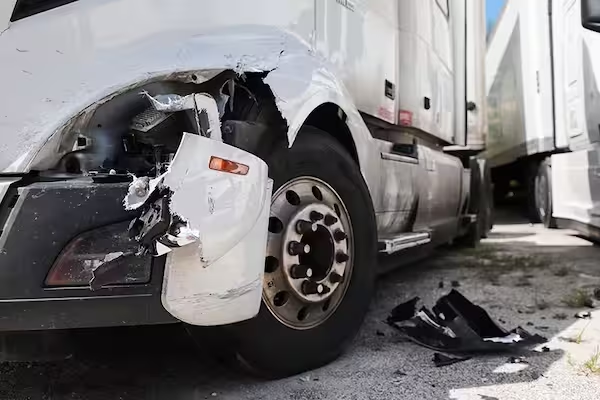
We handle injuries and deaths caused by many kinds of commercial vehicles, including:
Kansas highways often carry cattle and livestock trailers. These trucks are heavy, can be top-heavy, and may run long distances on tight schedules.
Some livestock haulers claim an "agricultural commodity" hours-of-service exception under 49 CFR 395.1(k). Once a driver goes beyond the 150 air-mile limit, log requirements can apply. We examine routes, time records, fuel, tolls, bills of lading, and other trip documents to test whether a driver followed the rules.
Farm tractors and implements sometimes enter the Wichita metro to reach grain elevators, repair shops, feed suppliers, and livestock facilities. These vehicles can be hard to see and may move much slower than normal traffic.
| Category | Statute/Rule | Common issue |
|---|---|---|
| SMV emblem & lighting | K.S.A. 8-1717 | Missing/dirty SMV emblem or improper lighting/reflectors |
| Highway movement limits | K.S.A. 8-1902 | Operating where restricted or without required compliance |
| Traffic flow | Kansas traffic rules | Impeding normal traffic without reasonable cause |
Wichita road projects and growth bring heavy construction traffic into normal commuter lanes. Construction trucks often stop suddenly, back up, and turn wide.
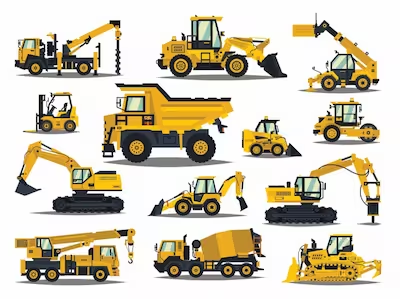
A truck can be DOT-legal on the road but unsafe or noncompliant on a work site.
| Truck type | Common federal safety rules involved |
|---|---|
| Dump trucks | Hours-of-service (49 CFR 395), brakes/tires (49 CFR 393), maintenance (49 CFR 396) |
| Flatbeds | Cargo securement (49 CFR 393.100-136) |
| Fuel trucks | HazMat rules (49 CFR 172-177) |
| All CMVs | Driver qualification (49 CFR 391), fatigue rule (49 CFR 392.3) |
| Area | OSHA standard (example) |
|---|---|
| Backing & blind spots | 29 CFR 1926.601 |
| Equipment inspection | 29 CFR 1926.20 and 1926.602 |
| Traffic control | 29 CFR 1926.200-203 |
| Cranes/boom trucks | 29 CFR 1926 Subpart CC |
Wichita sits at the intersection of agriculture, aerospace manufacturing, energy, rail, and interstate freight corridors. Local deliveries and long-haul routes all move through the metro daily.
Key freight corridors include:
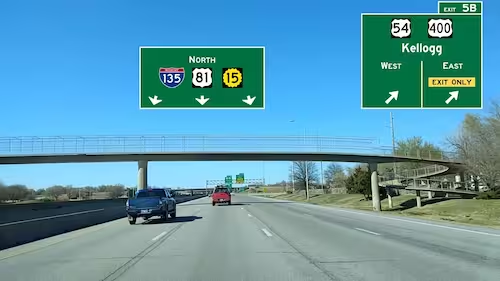
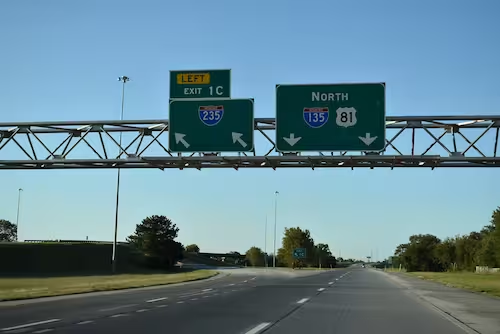
Different industries create different risks. We investigate the trucking company's safety plan, training, and cargo rules in each case.
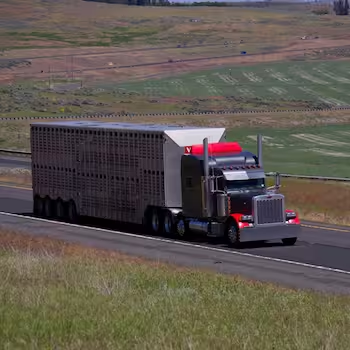
Cattle trailers, grain/hopper-bottom trailers, farm supply trucks (often long rural routes and heavy loads).
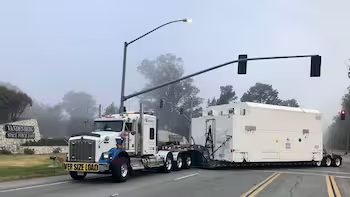
Dry vans, flatbeds, specialized carriers (tight delivery schedules and oversize loads).
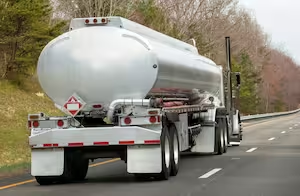
Fuel tankers, propane, vacuum trucks (hazmat risks and severe crash consequences).
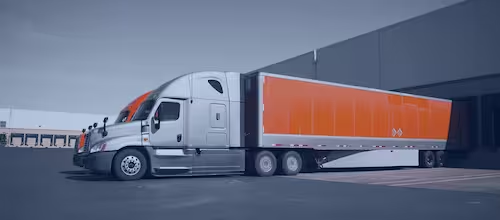
Semis, reefers, box trucks, final-mile vans (backing crashes, abrupt turns, schedule pressure).
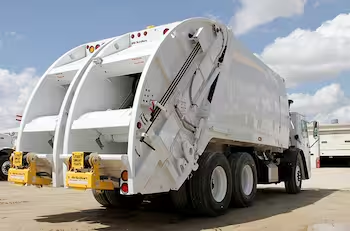
Garbage/recycling trucks, roll-offs, bucket trucks (frequent stops, blind spots, work zones).
Our job is to prove what happened, why it happened, and who is responsible. In truck cases, that often means proving safety-rule violations by the driver and the motor carrier.
Truck drivers and motor carriers must follow federal safety rules. When they break these rules and people get hurt, those violations can help prove negligence and increase accountability.
Source: ANSI/ASSP Z15.1 overview
"On-time" delivery requirements can encourage dangerous behavior. When companies punish drivers for delays, some drivers skip rest, speed, or keep driving while exhausted.
In our investigations, we look for evidence of:
Maintenance problems—especially brakes and tires—can turn a preventable situation into a catastrophic crash. Federal rules require systematic inspection and repairs.
Kansas weather also matters. High winds, ice, and low visibility can make semis unstable. Drivers must slow down and, when conditions are too dangerous, stop operating until it is safe.
Truck crashes often cause life-changing injuries. We pursue damages for:
CLIENT TESTIMONIALS
Real stories from real clients who trusted Bull Attorneys with their truck accident cases
“This place was very friendly and did everything in a very fast manner! They were also very respectful every time I called in or came in. 10/10 would recommend!”
“The Bull Attorneys are the best! Their work ethic is superbly untouchable. The Bull will always have a client with me because they are fast working and get the job well done.”
“Had great service with my case! Bull Attorneys came to my house to help me complete the paperwork when I was not able to drive and I really appreciated it.”
Truck accident and commercial vehicle cases are different from ordinary car wreck cases because truck drivers and motor carriers must follow additional safety rules. These rules create evidence—driver logs, electronic data, inspections, maintenance files, drug and alcohol testing, and company safety policies—that can prove why a crash happened and who is responsible.
At Bull Attorneys, our trucking litigation approach focuses on how federal DOT regulations, the Federal Motor Carrier Safety Regulations (FMCSR), CSA safety tracking, and recognized fleet-safety standards like ANSI/ASSP Z15.1 apply to real-world driver mistakes. In serious injury and wrongful death cases, this safety-rule evidence can help establish fault and support full compensation.
The following sections contain detailed legal and regulatory information for those seeking in-depth understanding of truck accident law, DOT regulations, and safety standards.
Why are large truck accidents confusing and complex? Because the truck driver and the trucking company operate under specialized safety regulations and safety systems. Understanding the FMCSR takes real study, and proving violations often requires fast evidence preservation.
Whether the truck driver or motor carrier is at fault often requires immediate evaluation of the crash scene and the truck's electronic systems (including tractor ECM/"black box" data where available). Trucking insurers and defense lawyers may begin a post-crash investigation quickly and can arrive at the scene within hours. That is why it helps to have a truck accident lawyer who can act quickly to protect evidence and your rights.
At Bull Attorneys, our immediate actions may include hiring accident reconstruction and trucking safety experts, preserving electronic and paper records, and analyzing safety-rule compliance to determine the root cause of the crash.
DOT-licensed motor carriers complete federal application materials and certify they will comply with federal safety rules. In practice, this means a trucking company should have real systems in place to follow the FMCSR and related safety requirements.
In our trucking cases, we look for whether the motor carrier had and followed systems to:
Why this matters to ordinary drivers: when a motor carrier does not build and enforce real safety systems, crashes become more likely. And when safety systems are missing or ignored, liability can be easier to prove and the value of an injury claim may increase.
Commercial motor vehicles (CMVs) operate under rules enforced by the Department of Transportation (DOT) and the Federal Motor Carrier Safety Administration (FMCSA). In serious truck crashes, the key question is often not only what the driver did, but what the motor carrier did—or failed to do—before the wreck.
Truck accident cases can require obtaining safety records, electronic data, logs, training files, and maintenance history. This is one reason truck crashes are different from ordinary car accidents.
The FMCSR are written safety rules for truck drivers and motor carriers. Under FMCSR provisions such as Part 390.3, carriers and drivers are expected to understand and follow applicable safety regulations. Motor carrier responsibility can extend beyond the driver to the company's hiring, training, supervision, assignment, and dispatch decisions.
Federal law also provides tools for accountability when safety violations cause harm. For example, 49 U.S.C. § 14704(a)(2) addresses damages arising from violations, and 49 U.S.C. § 14101(a) addresses a motor carrier's duty to provide safe and adequate service, equipment, and facilities.
Many business vehicles and heavy equipment operations can also trigger FMCSR coverage depending on weight, passenger count, and use. After a severe semi-truck collision, your lawyer must be able to prove negligence by the driver, the motor carrier, or both.
The FMCSR prescribe minimum safety standards for trucking companies and commercial drivers. When a carrier violates these standards, that violation can support liability in an injury case.
The regulations also require companies to instruct and manage drivers and employees on DOT safety rules. In truck accident litigation, understanding these rules can make the difference between a weak claim and a strong claim.
Crashes, injuries, and wrongful deaths often occur when drivers are not trained, supervised, or scheduled safely. A major focus in our cases is whether the motor carrier failed to train drivers in safe practices and defensive driving methods, such as hazard recognition and space management.
The FMCSA was established in 2000 with the goal of reducing crashes and fatalities. In real cases, we see recurring patterns: rushed schedules, fatigue, poor maintenance, and weak safety culture.
Bull Attorneys' trucking cases are managed with a safety-focused approach, informed by years of litigation against motor carriers, including depositions of drivers and safety leadership.
Truck drivers must have required knowledge to safely operate a tractor-trailer: the use of lights, horns, mirrors, emergency procedures, basic control maneuvers, and safe backing and turning. A strong trucking case often examines whether the carrier ensured the driver actually had this knowledge.
Safety areas commonly involved include:
"On-time delivery" requirements are one of the most controversial issues in commercial trucking. When drivers are rewarded or punished based on delivery times, it can encourage speeding and unsafe hours.
These policies may penalize drivers for delays. If evidence shows a driver was threatened with discipline, fines, suspension, or termination for late delivery, that can be powerful proof of unsafe scheduling and may support higher compensation.
Pushing drivers to deliver "on time" can lead to:
Experienced truck accident attorneys use FMCSR Part 396.3(a), which requires motor carriers to systematically inspect, repair, and maintain their commercial motor vehicles. A truck must have safe tires, brakes, and functioning safety equipment.
Truck drivers are required to conduct daily inspections before leaving, during the day, and at the end of the day. When drivers are fatigued and under pressure, inspections are often skipped or rushed.
FMCSR Part 396.7 prohibits operating a commercial motor vehicle when it is in a condition likely to cause an accident or breakdown. Part 396.11 addresses driver vehicle inspection reports (DVIRs) and documenting daily inspections.
Brake problems are a known contributor to rear-end and loss-of-control crashes. In serious cases, we examine maintenance records, inspection history, and repair delays.
Many trucking companies and drivers violate FMCSR Part 392.14 on hazardous conditions. Drivers must reduce speed in hazardous conditions like snow, ice, sleet, high winds, fog, and smoke. When conditions become sufficiently dangerous, operations should stop until it is safe.
In Wichita, Garden City, and across Kansas, high winds can cause catastrophic semi-truck crashes, including cross-centerline collisions when trailers are pushed by wind.
We examine weather warnings, dispatch decisions, speed, and route choices to determine if the carrier should have stopped operations.
Night operations create additional hazards: glare, reduced visibility, fatigue, and inexperience. Training and supervision should address nighttime space management, vision, and proper lighting use.
The FMCSA's Compliance, Safety, Accountability (CSA) program utilizes "BASIC categories" to monitor patterns of unsafe behavior and compliance issues. These categories are used to compare a motor carrier's performance against industry peers and to pinpoint risk trends.
The seven CSA BASICs are:
Unsafe Driving behaviors include speeding, improper lane changes, reckless driving, inattention, and illegal handheld phone use.
Truck accident attorneys can, in appropriate cases, request motor carrier safety information through lawful processes (such as public records requests) to assess compliance trends.
ANSI/ASSP Z15.1 is a standard designed to prevent crashes involving company vehicles by setting clear safety rules for how businesses operate cars, trucks, and fleets on public roads. It is a "road-safety playbook for companies—not just drivers."
ANSI/ASSP Z15.1 can help demonstrate preventability in crashes involving company vehicles if a company failed in areas like driver training, fatigue risk management, safety audits, or having a safety plan. This can support corporate negligence over just driver error.
For injury victims, this standard can shift focus from "driver messed up" to "company failed to manage safety," potentially leading to higher compensation and reinforcing the Doctrine of Preventability if basic safety practices were not followed.
Stay informed with our latest truck accident insights and legal guidance
View our locations and service areas above.
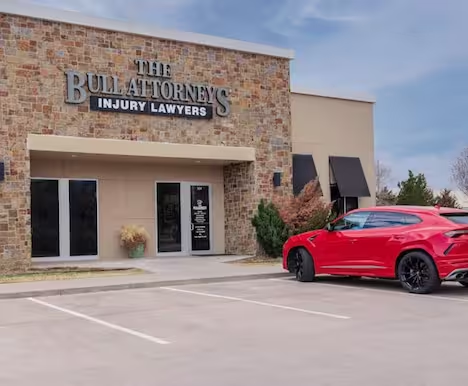
10111 E. 21st St. N #204
Wichita, KS 67206
Free consultation • No upfront costs
Not all lawyers are licensed in all states.