
MARCH 31, 2026
Truck Crashes, Delivery Driver Crashes, and Uber and Lyft Crashes Continue to Increase from 2022 Through 2025
INTRODUCTION
Nationally, IIHS says 4,354 people died in large-truck crashes in 2023, which was 38% higher than the 2009 low. Truck-crash trends are moving the FMCSA's Kansas summary for large trucks shows the number of fatal and non-fatal crashes involving those trucks rose from 1,627 in 2022, to 1,713 in 2023, and to 1,750 in 2024. Reported injuries from those crashes were 525, 517, and 556, respectively.
According to NHTSA, speeding and aggressive driving remain major contributors to serious crashes. NHTSA has also reported a large number of annual traffic deaths tied to impaired driving. Seat belt nonuse likewise continues to contribute to the percentage of traffic fatalities. These transportation-safety factors matter because they overlap with commercial transportation, delivery fleets, rideshare vehicles, and other business-use vehicles on Kansas roads.
FREIGHT MOVEMENT, HOME DELIVERY, AND TRAFFIC EXPOSURE CONTINUE TO RISE
Vehicle miles traveled (VMT) are on an uptick. FHWA projections show that combination-truck VMT and single-unit truck VMT are expected to keep growing as the country's traffic system becomes larger and more congested.
Like the national trend in traffic exposure, Kansas truck-crash trends remain concerning. FMCSA's Kansas summary for large trucks shows the number of fatal and non-fatal crashes involving those trucks at 1,627 in 2022, 1,713 in 2023, and 1,750 in 2024; reported injuries from those crashes were 525, 517, and 556, respectively.
Truck-specific physics and operating limits make these crashes especially dangerous. IIHS explains that trucks can weigh up to 30 times as much as passenger cars, their height and ground clearance create underride risks, and a loaded tractor-trailer may need 20% to 40% more distance than a passenger car to stop. IIHS also identifies driver fatigue as a known truck-crash risk. These factors make truck crashes especially severe even when total crash counts are not exploding.
Occupants of smaller passenger vehicles often suffer serious bodily injury, life-threatening injury, or death when they come into contact with larger trucks and commercial motor vehicles (CMV). When two motor vehicles of disproportionate size collide, it is usually the truck driver who comes out of the crash with fewer injuries because of the physics and forces involved.
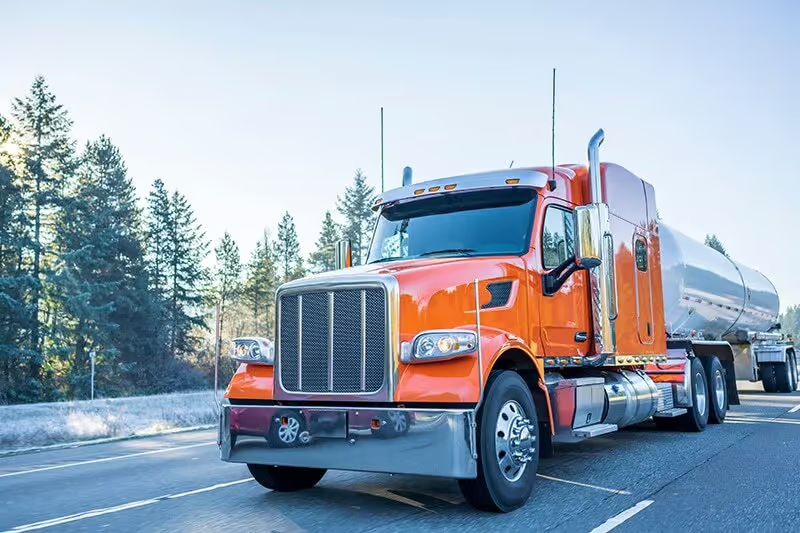
FACTORS THAT QUICKLY CONTRIBUTE TO CRASHES, SEVERE BODILY INJURY, AND FATALITIES
There are a number of factors which quickly contribute to crashes, severe bodily injuries, and fatalities in the transportation industry. The relevant factors include:
- Speed
- Impairment
- Distraction
- Nonuse of restraints
- More travel and freight exposure
- Rural high-speed roads
- Truck-specific braking, weight, and fatigue issues
DRIVERS SHOULD USE HEIGHTENED AWARENESS AROUND BUSINESS AND TRANSPORTATION VEHICLES
Drivers should use heightened awareness when approaching or coming near any large truck, business vehicle, business van, or delivery vehicle such as Amazon, UPS, Federal Express, and similar interstate-commerce business vehicles with fleet drivers.
Business vehicles and transportation vehicles include:
- Large trucks
- Delivery fleets
- Rideshare vehicles such as Uber and Lyft
- Business vehicles used for UberEATS, medication delivery, grocery delivery, pharmacy delivery, food and meal delivery, alcohol delivery, floral delivery, and other business-to-consumer delivery services

WHY THESE TRENDS MATTER
While the national trend of large-truck crashes declined somewhat during the most recent reported years, Kansas large-truck crashes increased from the 2022 low through 2024.
For delivery drivers, Uber, Lyft, and other business-fleet vehicles, the published data are more fragmented. Even so, the best available national data show rising delivery-driver injury exposure and higher rideshare fatality totals in the latest published reporting cycles. As of March 2026, the point-in-time picture is still limited because the main federal truck datasets are explicitly preliminary for the most recent period.
1) LARGE-TRUCK CRASHES IN KANSAS
FMCSA's Kansas large-truck summary, based on an MCMIS snapshot dated February 27, 2026, shows these annual totals for large-truck crashes in Kansas:
- 2021: 1,806 crashes; 71 fatal crashes; 86 deaths; 532 injuries
- 2022: 1,627 crashes; 69 fatal crashes; 79 deaths; 525 injuries
- 2023: 1,713 crashes; 50 fatal crashes; 55 deaths; 517 injuries
- 2024: 1,750 crashes; 58 fatal crashes; 65 deaths; 556 injuries
- 2025: only 126 crashes shown in that table, but FMCSA also warns that MCMIS data are preliminary for 22 months, so the 2025 row should not be treated as a full-year trend line
KANSAS TREND TAKEAWAYS
Total large-truck crashes fell sharply in 2022, then rose in 2023 and again in 2024.
Fatal crashes fell in 2023, then rose in 2024.
Deaths fell from 86 in 2021 to 55 in 2023, then rose to 65 in 2024.
Reported injuries were highest in 2024 among the last four reported years.

2) LARGE-TRUCK CRASHES IN THE UNITED STATES
FMCSA's national large-truck summary shows the opposite overall direction:
- 2021: 170,400 crashes; 5,293 fatal crashes; 5,949 deaths; 77,358 injuries
- 2022: 159,933 crashes; 4,836 fatal crashes; 5,376 deaths; 75,524 injuries
- 2023: 157,355 crashes; 4,222 fatal crashes; 4,719 deaths; 74,576 injuries
- 2024: 147,621 crashes; 3,682 fatal crashes; 4,087 deaths; 71,574 injuries
- 2025: partial data only in the February 27, 2026 snapshot
3) DELIVERY-DRIVER CRASHES AND DELIVERY-FLEET TRENDS
This statistical information is harder to locate, but the best published evidence shows delivery exposure and injury burden rising.
The Bureau of Labor Statistics (BLS) defines delivery truck drivers as drivers who pick up and deliver packages and small shipments in local or urban areas. BLS says light truck drivers held about 1.1 million jobs in 2024, with 37% employed in couriers and messengers. BLS also notes that driving in congested traffic and working under tight delivery schedules is stressful.
A government-published article entitled "Trends in parcel delivery driver injury: Evidence from NEISS-Work" reports that emergency-department treatment for injuries involving postal workers and couriers/messengers shows an upward trajectory. Courier and messenger injuries requiring an emergency-room visit rose while the overall United States industry rate trended downward.
IIHS also found that light vans were involved in an average of 155,895 police-reported crashes, 16,352 injury crashes, and 606 fatal crashes per year during the study period it examined. IIHS said the growing prevalence of these vans is a safety concern because of their mass and front-end design, especially for smaller vehicles and pedestrians. These vans are used heavily in the delivery industry because of their ability to hold more cargo for more deliveries at one time.
The BLS Occupational Outlook Handbook projects that the industry for delivery truck drivers and driver/sales workers will grow by 6% from 2024 through 2034, adding an average of 71,400 job openings each year. Light truck and van delivery drivers commonly report to hub operations at the start of the day to pick up cargo for delivery, which can create dangerous traffic conditions near those facilities.
Drivers are expected to deliver on time or face monetary penalties, wage penalties, suspension, or job loss. The on-time push contributes to fatigue, hurrying, and traffic-law violations, which lead to more motor vehicle crashes. Many must work early in the morning and continue delivering into the night with little or no meaningful time for breaks.
Thus, delivery-vehicle exposure and injury burden have risen, and light-van crash involvement is substantial nationally. Those trends are likely to continue as consumer demand for home delivery continues to rise.
4) UBER CRASH TRENDS
Uber's official safety page confirms that it has published United States safety reports for 2017-2018, 2019-2020, and 2021-2022.
From Uber's 2017-2018 report, there were 107 total fatalities across 97 fatal Uber-related crashes.
From Uber's 2019-2020 report, there were 101 motor-vehicle fatalities across 91 fatal Uber-related crashes. Uber also reported that fatalities per vehicle mile traveled increased 7% versus the 2017-2018 period, that 33% of fatalities involved at least one risky behavior such as speeding, alcohol impairment, or wrong-way driving, and that 42% of fatalities were vulnerable road users.
For Uber's 2021-2022 cycle, Uber's official site links the report, and other reporting on that report reflects 127 fatal Uber-related crashes resulting in 153 deaths.
The fatality trend in the published report cycles is as follows:
- 2017-2018: 107 fatalities / 97 fatal crashes
- 2019-2020: 101 fatalities / 91 fatal crashes
- 2021-2022: 153 fatalities / 127 fatal crashes
ADDITIONAL UBER OBSERVATIONS
It is important to remember that non-fatal injury crashes are far more numerous than fatal crashes.
Uber's published United States Safety Report for 2021-2022 provides Uber's own analysis of its safety record from 2017 through 2022 and shows a steep rise in fatalities in the latest reporting cycle.
Uber has not published a later United States safety report after the 2021-2022 cycle, even though its earlier safety-reporting cadence suggested recurring publication.
Uber also has not published comprehensive public crash statistics for all injury and property-damage-only crashes that do not involve a fatality.
Public reporting and litigation involving Uber have also increasingly involved not only traffic collisions but allegations of sexual assault by drivers against passengers.
The New York Times published a major investigative article on rideshare safety that raised serious safety concerns regarding the rideshare model.
The United States Government Accountability Office has reported concerns about incomplete or inconsistent public reporting by ridesharing companies of injuries, fatalities, and sexual assaults in the rideshare industry. For that reason, the true scope of rideshare crash injury exposure may be higher than what the public fatality counts alone suggest.
5) LYFT CRASH TRENDS
Lyft's first safety report showed these motor-vehicle fatality counts:
- 2017: 22
- 2018: 34
- 2019: 49
LYFT'S FIRST REPORT PERIOD
That is 105 fatalities total for 2017 through 2019.
Lyft's 2020-2022 report then showed:
- 2020: 25
- 2021: 36
- 2022: 50
LYFT'S MOST RECENT PUBLISHED CYCLE
That is 111 motor-vehicle fatalities total from 2020 through 2022. Lyft said this represented a 14% increase in the rate per 100 million vehicle miles traveled from the prior reporting period, and Lyft also said that while overall crash frequency decreased between 2020 and 2022, fatal crashes increased.
Lyft's published trend is also upward in fatality severity in the most recent report cycle. Like Uber, Lyft stopped publishing safety reports after the 2022 period. The last year publicly reported in that cycle is 2022.
6) OTHER BUSINESS-FLEET / COMPANY-VEHICLE TRENDS
Fleet vehicle statistics are much harder to find in published reports, but those reports still provide evidence of concern. Fleet vehicles can be any business with more than one company vehicle using motor vehicles in transportation to conduct business and produce revenue.
The BLS did publish statistics for driver/sales workers and truck drivers:
- 2021: 1,032 fatal occupational injuries, including 814 transportation incidents
- 2022: 1,115 fatal occupational injuries, including 895 transportation incidents
- 2023: 984 fatal occupational injuries, including 763 transportation incidents
- 2024: 950 fatal occupational injuries, with an hours-based fatal-injury rate of 25.7 per 100,000 full-time equivalent workers
OVERALL TREND SUMMARY
- Kansas large trucks: up from the 2022 low through 2024; 2024 was worse than 2023 on total crashes, fatal crashes, deaths, and injuries.
- United States large trucks: not increasing over the last four reported annual years; FMCSA shows a decline from 2021 through 2024.
- Delivery-driver / parcel fleets: the strongest evidence shows rising exposure and injury burden, with light vans involved in large numbers of crashes nationally and courier/messenger injury rates trending upward.
- Uber: the latest published cycle appears higher than the prior cycle.
- Lyft: the latest published cycle also shows higher fatality totals and higher fatality rates.
- Other business fleets: occupational roadway-death data show a 2022 peak followed by improvement, not a steady increase straight into 2024.
Author: Bradley A. Pistotnik (Trial Lawyer)
Brad Pistotnik is the CEO of Bull Attorneys®, P.A. and a Kansas trucking and personal injury lawyer with over 45 years of experience. He focuses on serious injury and truck accident cases involving DOT regulations and commercial vehicle safety standards.
View Brad's Full Profile→Page last reviewed: 03/31/2026 by Bradley A. Pistotnik.
We Are Hereto Help
Call for a free consultation 24/7